Hiring Problem
Companies implementing SAP IBP for demand planning often hire external consultants. The expectation is simple. The consultant should understand demand planning and help the organization produce better forecasts.
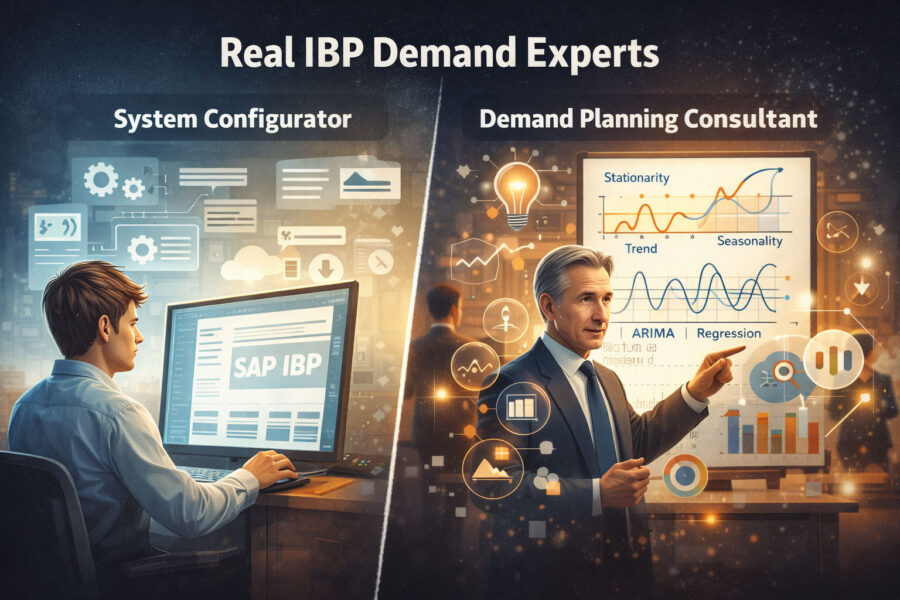
In practice many hiring managers struggle to distinguish between two very different profiles.
One profile is the configurator. This person understands the SAP IBP system, knows how to configure planning areas, and can activate forecasting algorithms inside the tool.
The second profile is the demand planning consultant. This person understands how demand behaves, how statistical models work, and when different forecasting approaches should be used.
The difference becomes visible quickly during a conversation.
The Key Question
A simple test helps reveal the difference.
Ask the consultant which forecasting models should be used in different demand situations and why.
A genuine demand planning consultant should immediately begin discussing demand characteristics such as stationarity, trends, seasonality, and autocorrelation.
A configurator may respond by listing SAP functionality.
The distinction matters because forecasting accuracy depends far more on understanding demand behaviour than on configuring software screens.
Stationary Demand
Some products exhibit relatively stable demand over time.
In these cases the demand series fluctuates around a constant average without long term trends or repeating seasonal cycles.
For such products, simple statistical models often perform well. Moving average methods and simple exponential smoothing belong to this category. These models assume that the underlying demand process remains stable and that recent observations provide the best signal for predicting the next period.
Many slow moving industrial spare parts and stable consumer products behave this way.
The forecasting problem becomes straightforward.
Demand Shifts
Other products experience abrupt changes in demand levels.
Promotional activity, market shifts, or sudden distribution changes may cause demand to move quickly from one level to another.
In these situations models such as Brown’s double exponential smoothing become useful because they respond faster to level shifts than simpler smoothing techniques.
The important point is that the model choice follows the behaviour of demand, not the configuration preferences of the software.
Trending Demand
Some products display consistent upward or downward movement over time.
Growth products entering new markets often show upward trends, while mature products sometimes experience gradual decline.
Holt’s forecasting model addresses this pattern by incorporating a trend component alongside the level estimate.
Without explicitly modeling the trend, forecasts may systematically lag behind the real demand trajectory.
Trend handling therefore becomes essential in many product categories.
Seasonal Patterns
Certain products exhibit both trends and recurring seasonal cycles.
Examples include retail merchandise, consumer electronics, and many food products where demand peaks during specific periods of the year.
The Winters model extends earlier smoothing approaches by incorporating both trend and seasonality.
This allows the forecast to capture repeating seasonal patterns while still responding to longer term directional changes.
Demand planners working in consumer industries rely heavily on this type of modeling.
Complex Series
Some demand patterns show autocorrelation without obvious seasonal cycles.
In such cases ARIMA models often provide useful forecasting frameworks. These models capture relationships between past observations and future demand values.
When seasonal effects also appear, SARIMA models extend the approach by incorporating seasonal components into the autoregressive structure.
Regression models represent another powerful approach. Here the forecast relies on external variables that influence demand. Price changes, advertising activity, macroeconomic indicators, or weather patterns may all serve as explanatory variables.
In these situations the forecast reflects the relationship between demand and its drivers rather than relying purely on historical demand patterns.
Consensus Planning
Real world forecasting rarely depends on statistical models alone.
Organizations frequently combine multiple perspectives when producing a final forecast.
Sales teams provide field intelligence. Marketing departments contribute campaign expectations. Financial planning functions supply budget targets. Statistical models generate baseline projections.
A consensus forecast often combines these inputs through weighted aggregation. The weights may reflect historical correlations between each input and actual sales performance.
For example, a statistical forecast might contribute forty percent of the final forecast, while sales, marketing, and planning inputs supply the remainder.
This blended approach often produces more reliable results than any single forecasting method.
Advanced Methods
Modern analytics introduces additional forecasting approaches.
Bayesian models incorporate prior knowledge or expert beliefs into the forecasting process. Unlike classical time series models, Bayesian approaches generate probability distributions rather than single point forecasts.
Machine learning techniques such as Prophet or long short term memory networks address extremely complex demand patterns involving multiple seasonal cycles, irregular data structures, or massive transaction volumes.
These techniques appear frequently in retail, digital commerce, and social media analytics where demand signals evolve rapidly and large datasets exist.
The Real Distinction
The purpose of this discussion is not to promote a particular forecasting technique.
The purpose is to highlight the difference between configuring software and understanding demand.
A consultant who understands forecasting theory can evaluate which model suits a particular demand pattern. A configurator may only know how to activate algorithms inside the software environment.
Organizations implementing SAP IBP require both skills.
However only one of them qualifies as demand planning expertise.
When hiring consultants, the ability to explain forecasting models clearly usually reveals who understands the subject and who simply operates the tool.
Incidentally some people call these techniques artificial intelligence or machine learning.
Others simply call them statistics.