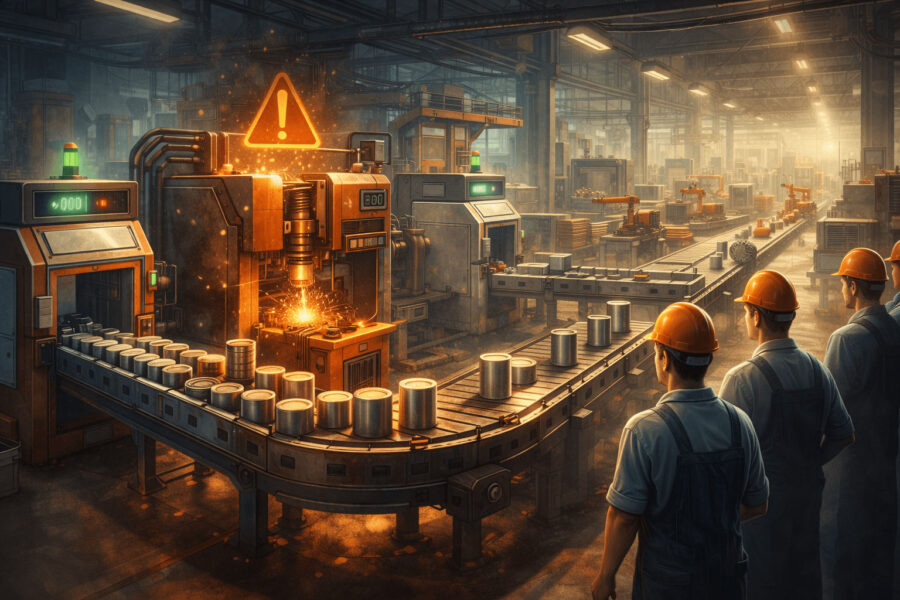
The Manager’s Question
Production managers frequently ask a practical question.
How can we identify which resources in a factory are truly constrained?
Factories contain many types of resources. Machines, work centers, tools, and people all contribute to the flow of work. Managers often assume that the most heavily used resource automatically becomes the constraint in the system.
The reality is slightly more subtle.
A useful operational guideline begins with utilization levels. When a machine, work center, or human resource consistently operates above roughly eighty percent utilization over several months, the resource should be treated as constrained. At that point the organization begins discussing optimization rather than basic planning.
When utilization remains well below that level, traditional planning approaches such as material requirements planning usually work well enough.
The factory still has capacity to absorb variability.
Capacity Signals
A useful reference point for production managers sits around two thirds utilization. When utilization remains below roughly sixty six percent, capacity typically exceeds demand comfortably.
Planning in this environment focuses primarily on material availability and order sequencing. Capacity rarely becomes the primary problem.
As utilization approaches eighty percent, the system enters a different operating regime. Small disturbances begin to produce larger consequences. A short machine stoppage or a delayed material delivery can disrupt several downstream orders.
At that stage planners begin paying close attention to resource loading.
Constrained resources represent locations where the factory struggles to meet demand with the capacity currently available.
Bottleneck Confusion
Managers often assume that once constrained resources appear, the bottleneck in the factory becomes obvious.
In practice bottlenecks move constantly.
A machine that appears overloaded during one week may operate comfortably during the next shift. Material delays, staffing patterns, maintenance interruptions, and order sequencing all influence which resource slows the system at any given moment.
Visual inspection of the shop floor remains one of the most reliable ways to observe this behavior.
Queues forming at certain work centers usually indicate that work flows more slowly through that location. However the same location may operate smoothly during a different production cycle.
The identity of the bottleneck rarely remains fixed.
Scheduling Heuristics
SAP production planning systems attempt to manage these dynamics through scheduling heuristics.
Heuristics such as SAP003, which attempts to fix bottleneck resources, or SAP005, which schedules bottleneck operations first, guide the system when it creates production schedules.
These algorithms do not guarantee an optimal outcome.
They produce schedules based on predefined rules. When planners mark a resource as a bottleneck, the scheduling logic may overload that resource in order to prioritize certain operations. The result can shift delays to other parts of the production system.
Order start dates may move. Due dates may slip. Certain work centers may remain idle while others become overloaded.
The software generates a schedule. Human judgment still determines whether the schedule makes sense.
Multiple Bottlenecks
Factories sometimes designate several resources as potential bottlenecks.
This practice can help planners explore different scheduling scenarios. However marking too many resources as bottlenecks quickly creates confusion. A useful rule limits bottleneck designations to a small portion of the resource pool.
In most environments no more than five percent of resources should carry the bottleneck designation.
When too many resources receive this label, scheduling logic begins competing with itself.
The production plan becomes harder to interpret rather than easier.
False Bottlenecks
Another complication appears when a resource behaves like a bottleneck without being structurally constrained.
Unexpected machine downtime can produce queues that resemble bottleneck behavior. Missing materials may prevent operators from processing orders. Staffing gaps may slow work at certain stations during particular shifts.
In these cases the resource itself may have sufficient capacity. Temporary operational disruptions create the appearance of a constraint.
A familiar analogy appears at immigration counters in airports. The counter infrastructure may handle large passenger volumes. Yet long queues sometimes form because individual officers process travelers slowly or leave their stations frequently.
The system is not constrained by design. The operational behavior creates the bottleneck.
Factories experience similar situations.
Economic Judgment
Production planning systems provide powerful tools for scheduling and capacity analysis. However they do not replace managerial judgment.
A skilled production manager understands the economic impact of scheduling decisions. Some orders carry high financial or customer service risk if delayed. Others have little operational consequence.
Managers must evaluate the value at risk associated with different scheduling outcomes. The decision may involve delaying one order in order to protect another that carries greater commercial importance.
Software can generate schedules quickly. Understanding the consequences of those schedules requires human interpretation.
Practical Advice
Organizations sometimes embark on advanced production scheduling projects believing that software alone will optimize their factories.
The reality requires more discipline.
Consultants configuring scheduling heuristics must understand the operational consequences of their recommendations. Customer service rules, industry practices, and shop floor realities all influence which heuristics make sense in a particular environment.
Production teams must also receive clear guidance on when to apply different scheduling rules.
Enterprise systems reveal the structure of the production process. They do not eliminate the need for thoughtful operational judgment.
Factories that recognize this balance usually achieve far more stable planning results than those that rely entirely on algorithms.