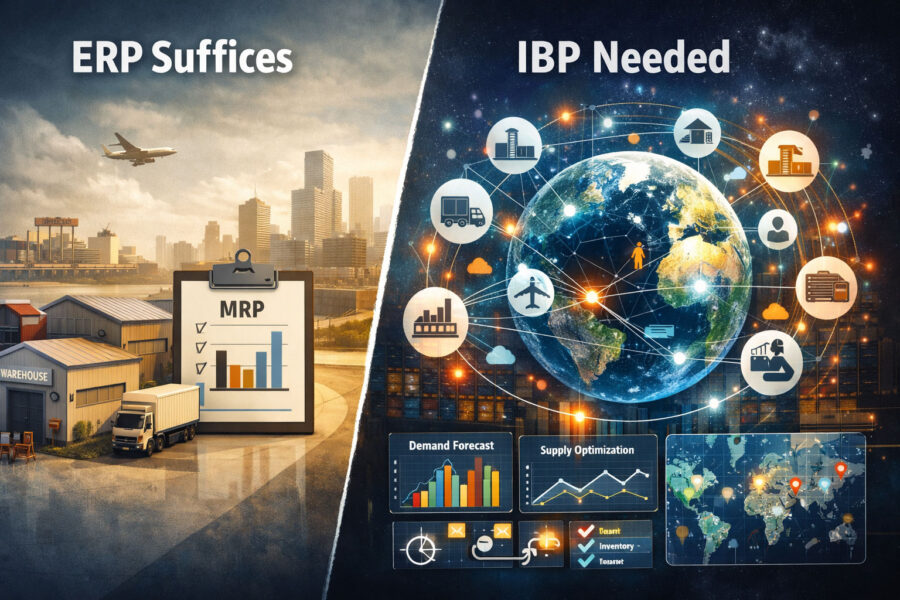
The Basic Question
One of the more sensible questions an operations leader can ask is this.
Why do I need SAP IBP when SAP S/4HANA already seems to cover my demand and supply planning needs?
The answer is less glamorous than many software presentations suggest.
If your business can live with basic product-by-location forecasting, straightforward material requirements planning, and relatively stable supply conditions, then you may not need SAP IBP at all. If production capacity is rarely constrained, warehousing is simple, and sourcing choices are limited, S/4HANA can often handle the job well enough.
There is nothing intellectually inferior about staying with simpler planning. Many organizations get into trouble because they buy planning sophistication before they earn the right to use it.
When ERP Suffices
S/4HANA works well when the planning problem remains structurally manageable.
This usually means the business has one main ERP landscape, a relatively clean product and location structure, limited supply alternatives, and a planning process that does not require constant re-optimization. The forecast can remain at a practical aggregate level, and MRP can convert that demand into supply proposals without creating damaging distortions.
In this environment, adding IBP may create more administrative effort than business value. A more advanced planning layer will not rescue a company from weak master data, poor process discipline, or confused ownership. It will simply automate those weaknesses faster.
That is why the first decision is never about software capability. It is about whether the planning problem itself has outgrown ERP logic.
Network Complexity
IBP begins to matter when the network becomes more complex than a single ERP instance can represent cleanly.
A common example appears in multinational organizations with several ERP systems. Different countries may buy from the same vendor or contract manufacturer, while each legal entity still requires its own procurement documents and local execution. In that situation, planning may need to be centralized partially or fully, while execution remains local.
ERP systems are good at executing transactions inside their own boundaries. They are less elegant at coordinating planning logic across several independent execution landscapes.
IBP earns its place when the enterprise wants one planning brain and several execution arms.
Conditional Sourcing
Another trigger appears when the source of supply depends on many variables at once.
A vendor may look attractive on price but weak on lead time. A plant may be cheaper in one quarter and capacity constrained in the next. Contractual obligations may require volume commitments even when another source looks operationally better. Customer priorities may also override pure cost logic.
At that point, supply planning becomes a trade-off exercise rather than a basic replenishment routine.
ERP can store these relationships, but it does not naturally reason through them across a changing network. IBP becomes useful when sourcing is conditional, dynamic, and sensitive to competing business rules.
Overlapping Stock
IBP also starts making sense when several plants and warehouses hold similar or overlapping inventory.
A business may ask whether a customer in eastern India should be served from a warehouse in Bengal, from a plant in Maharashtra, or from another warehouse that happens to have excess stock. The question is no longer whether inventory exists. The question is where the enterprise should fulfill from in order to balance service, freight, lead time, and stock health.
Basic ERP planning is rarely designed to think across the entire network this way. It will execute within the structures it knows. IBP becomes valuable when the organization needs network-level visibility and decision support.
Ugly Tiers
Some supply chains contain layers that no one loves but everyone inherits.
Regional warehouses feed local warehouses, which then feed distributors. Products pass through several stocking points because geography is inconvenient, infrastructure is weak, demand is patchy, or supply lines are unreliable. These networks often survive for historical reasons long after their elegance has disappeared.
ERP can execute transactions through these tiers, but execution alone does not answer whether the stocking logic remains sensible or whether the inventory posture across the network still supports the business. IBP helps when the enterprise must plan through these necessary complications rather than pretend they do not exist.
Fast Response
A different case emerges when the business must react quickly to changing demand.
Fast moving consumer goods, spare parts, MRO supply, and quick commerce all create environments where demand signals move faster than traditional planning cycles. The business cannot wait for a monthly forecast review followed by a routine MRP run. It needs a planning layer that can absorb demand changes, compare them against supply realities, and guide response decisions more quickly.
This is where IBP can justify itself.
Its value lies less in fashionable terminology and more in response speed. When the planning clock of the business runs faster than ERP planning can comfortably handle, IBP becomes a practical tool rather than a prestige purchase.
Rich Forecasting
Forecasting complexity also matters.
Some businesses forecast effectively at SKU and location level. Others need a more nuanced view. Fashion, footwear, food service, and premium consumer products often need to read demand through attributes, sub-brands, product families, and location characteristics. A small event can shift demand sharply. A local promotion, weather pattern, festival, or social signal may distort the forecast quickly.
In such environments the business needs to see and update demand through multiple dimensions. ERP forecasting tends to become rigid here. IBP becomes more useful because it supports more flexible planning structures and richer forecasting logic.
Implementation Reality
The harder truth is that IBP should not be implemented by a mere configurator.
The software can be configured by many people. Good planning judgment is rarer. A serious IBP consultant should understand supply, demand, and production planning from real operating environments before touching the software. Tool knowledge matters, but it comes second.
As for cost, a focused IBP demand planning and demand sensing implementation can often be done for under 100,000 USD in around three calendar months. Expanding into supply planning, S&OP, and inventory optimization may add roughly 200,000 USD and another three months.
Those numbers are attractive enough to tempt impulsive decisions.
Resist that temptation.
IBP can become useful planning infrastructure, or it can become another expensive typewriter. The difference lies in whether the business actually needs a more advanced planning brain, and whether the people implementing it understand planning before they understand the tool.