The Question from Early in a Career
Many years ago, early in my SAP career, I asked what seemed like a perfectly logical question.
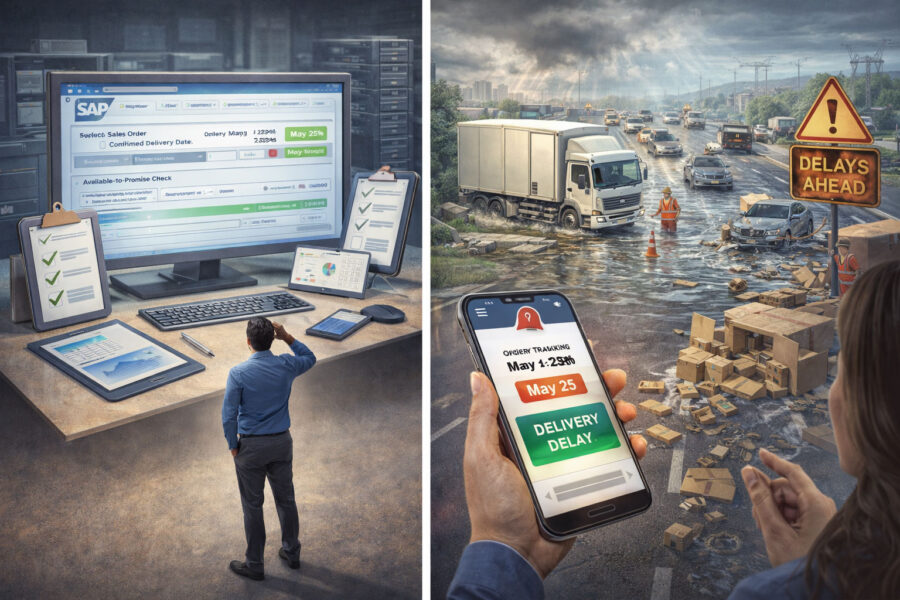
If the confirmed delivery date of an order changes because of backorder processing, should the customer automatically be informed?
From a system perspective the logic appeared straightforward. The ATP check calculates availability. Backorder processing reallocates inventory when priorities change. If the confirmation date moves, the customer should know.
In theory the idea made perfect sense.
The System’s View of the World
Enterprise systems operate through structured logic. Inventory levels determine availability. Production orders create future supply. Transit times determine delivery dates. Algorithms evaluate priorities and assign stock to the most appropriate orders.
Inside that model, the system produces rational answers.
The problem is that the model represents only part of the real world.
The World Outside the System
Real supply chains contain variables that no planning system can fully anticipate.
Transport delays occur because of road conditions or weather. Suppliers miss shipments because their own facilities experience disruptions. Quality inspections may delay stock releases for valid operational reasons. Production lines stop unexpectedly.
Even when a warehouse contains adequate stock, deliveries may still fail to reach customers on time for reasons entirely unrelated to the planning system.
The ATP calculation therefore reflects an assumption rather than a guarantee.
The Limits of System Thinking
ERP specialists sometimes view operational challenges primarily through the configuration of the modules they work with. Planning specialists focus on planning parameters. Inventory specialists examine stock categories. Logistics teams analyse delivery scheduling.
Each perspective contributes to the overall solution, though none of them individually represents the entire system of reality in which the business operates.
Operational decisions frequently require broader understanding that extends beyond system configuration.
The Business Context
Customers rarely care which system logic produced a delivery commitment. They care whether the delivery arrives when promised. The difference between theoretical availability and actual delivery capability becomes painfully visible whenever supply chain disruptions occur.
In that moment the question is no longer about configuration settings. It becomes a question of operational judgement, communication, and customer management.
The Human Dimension
Enterprise systems are powerful tools for organising complex operations. They help companies coordinate production, inventory, and logistics across large networks. Yet they remain tools rather than complete representations of reality.
People operating those systems must therefore maintain awareness of the broader economic and operational environment.
Business understanding matters just as much as technical expertise.
The Larger Lesson
ERP professionals sometimes become deeply specialised in particular modules or configuration areas. That expertise is valuable, though it can also create narrow perspectives if it becomes detached from the operational realities those systems are meant to support.
The most effective practitioners understand both the system and the world in which the system operates.
Enterprise software models business processes. Real businesses operate within far more complicated environments. Understanding that difference is often the beginning of better decisions.