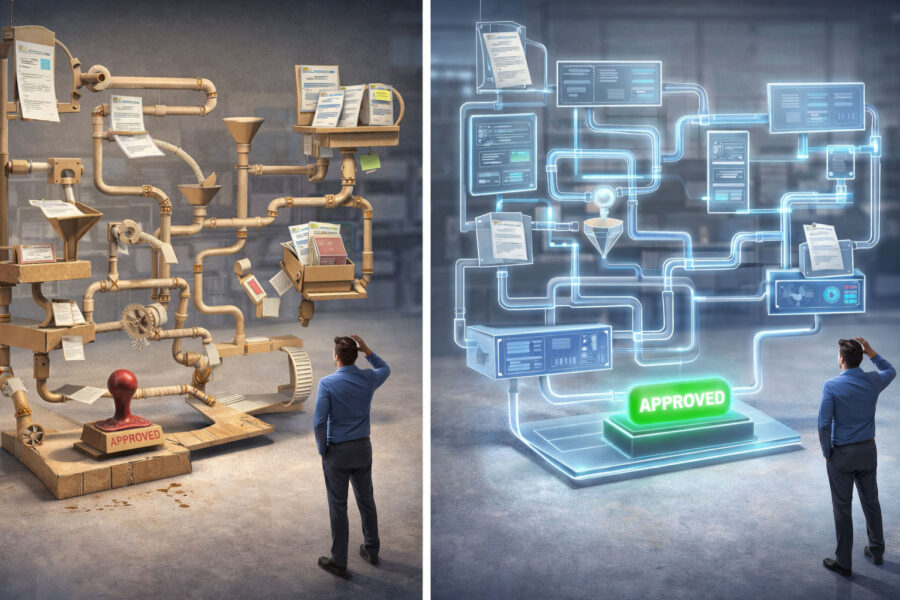
The Assumption Behind Digital Transformation
Many organisations assume that introducing digital tools automatically improves business operations. Mobile applications replace paper forms. Workflows replace manual approvals. Dashboards replace spreadsheets. The expectation is that efficiency will naturally follow.
In practice the outcome is often very different.
Digitising a process does not necessarily simplify it. It frequently preserves the same inefficiencies in a more technologically sophisticated form.
Digitisation Is Not Simplification
A process may become digital while remaining just as complicated as before. Consider a mobile expense reimbursement system that still requires employees to manually enter project codes, cost centres, and accounting references.
From a technical perspective the process has become digital. The employee submits the request through a mobile interface rather than filling out a paper form. Yet the fundamental experience remains unchanged. The user still performs the same administrative tasks.
A system designed properly would populate these values automatically from existing enterprise data. When this does not happen, the technology has simply transferred the burden from paper to a smartphone screen.
Automation Is Not Productivity
Automation can accelerate repetitive tasks, but only when the underlying process is designed correctly. Automating a poorly designed workflow merely accelerates confusion.
For example, a purchase requisition system may allow employees to submit requests digitally from a mobile device. However, if the approval workflow still takes several days because of poorly structured validations or missing contract checks, the procurement process has not truly improved.
In such cases purchase orders often require correction after approval because the system lacks the information necessary to validate requests properly at the beginning.
The process becomes faster at submitting errors rather than preventing them.
Integration Is Not Synchronisation
Systems can be technically integrated without actually operating in harmony. Integration may allow data to move between systems while leaving process inconsistencies unresolved.
If expense management systems are not properly connected with the ERP platform, employees may still enter information that already exists elsewhere in the organisation’s data environment.
The result is duplication rather than synchronisation.
AI Is Not Understanding
Artificial intelligence often promises deeper insight into business operations. Yet even advanced analytical tools cannot compensate for poorly designed processes or inconsistent data structures.
Machine learning models rely on clear, structured inputs. When the underlying processes generating that data remain disorganised, AI systems simply analyse flawed information more quickly.
The Real Transformation
True digital transformation begins with process design rather than technology selection. Organisations must first ask how work should ideally flow across the business. Only after that question is answered should technology be introduced to support the redesigned process.
When technology merely overlays existing inefficiencies, the result becomes cosmetic rather than transformational.
Lipstick on Inefficiency
Many digital initiatives are presented as success stories because they demonstrate modern interfaces or automated workflows. Case studies highlight mobile access, advanced analytics, and integrated systems.
Yet the real measure of improvement lies elsewhere. Does the process require fewer steps? Do users spend less time on administrative tasks? Do decisions occur faster and with better information?
If the answer to these questions remains unchanged, the organisation has not achieved transformation. It has simply placed a digital layer over the same operational inefficiency.