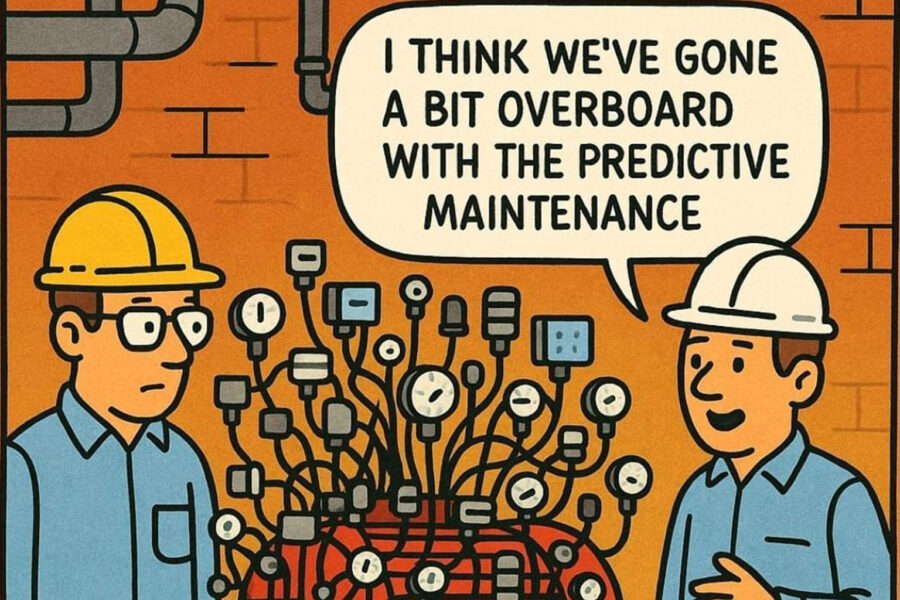
The Conversation That Keeps Appearing
In discussions about modern manufacturing technology, one phrase appears with remarkable frequency. Predictive maintenance. The phrase often arrives surrounded by other fashionable terms. Digital twins. Predictive analytics. Control towers. Robotic process automation. The vocabulary of enterprise technology has expanded rapidly in recent years, and many conversations about ERP systems now sound like catalogues of futuristic concepts.
Occasionally one hears someone pause and remark, half jokingly, that the industry may have gone slightly overboard with the enthusiasm.
The Historical Perspective
Predictive maintenance itself is not a new concept. Long before modern cloud platforms and machine learning tools became fashionable, engineers were already attempting to anticipate equipment failure. Techniques such as vibration monitoring, oil analysis, and statistical reliability studies existed decades ago. Some industrial facilities experimented with these methods as early as the late twentieth century.
The objective was always the same: reduce unexpected downtime by identifying early signs of equipment deterioration. Sensors, measurements, and historical analysis helped maintenance teams intervene before machines failed.
Modern technology has expanded the tools available for this purpose. Data collection has become easier, storage cheaper, and analytical capabilities more powerful. Yet the underlying principle remains unchanged.
The Buzzword Expansion
What has changed more dramatically is the language surrounding these ideas. The vocabulary of enterprise technology has become increasingly elaborate. Consultants frequently describe transformation programmes using expressions that sound sophisticated and futuristic.
Digital twins promise virtual replicas of physical operations. Predictive analytics suggests algorithmic foresight. Control towers evoke centralised visibility across entire supply chains. Robotic automation hints at the replacement of routine tasks by software agents.
Each of these concepts has legitimate applications in the right context. The difficulty arises when the language travels faster than the operational understanding behind it.
When Words Replace Experience
In many conversations about manufacturing systems, the enthusiasm for terminology occasionally exceeds familiarity with the environments those systems are meant to serve. Some participants speak confidently about advanced maintenance strategies despite limited exposure to real production facilities or shop floor operations.
This gap between vocabulary and experience can lead to unrealistic expectations. Technology begins to sound like a universal solution rather than a tool applied to specific operational problems.
What ERP Systems Actually Do
Enterprise resource planning systems were originally designed to solve practical coordination problems inside organisations. They help companies plan production, manage inventory, track financial transactions, and coordinate complex operational processes.
These systems excel when they address concrete business challenges. They provide structure to planning, visibility to transactions, and discipline to operational workflows. When implemented thoughtfully, they improve reliability and transparency across the organisation.
They are less effective when they become vehicles for fashionable terminology rather than practical problem solving.
The Role of the Consultant
Consultants working with enterprise systems occupy a very practical professional role. Their responsibility is not to repeat fashionable language but to understand business processes and apply appropriate tools to improve them. This requires familiarity with system capabilities, operational constraints, and the economic consequences of design choices.
In many ways the work resembles other skilled trades. The consultant analyses a problem, selects appropriate tools, and applies them carefully to produce a functional result. The value lies in execution rather than vocabulary.
The Risk of Empty Language
When technical discussions drift too far into fashionable terminology, language begins to lose meaning. Words that once described specific technical ideas become generic signals of sophistication. Eventually every presentation contains the same set of phrases, regardless of whether those ideas are actually relevant to the situation being discussed.
At that point the terminology stops helping people understand technology. It simply becomes decoration.
A More Practical Approach
The most useful conversations about enterprise technology return to practical questions. What operational problem are we trying to solve? What capabilities already exist within the system? What alternative approaches are available? How will the organisation actually run the solution once the consultants leave?
These questions may sound less glamorous than discussions about digital twins or predictive algorithms. Yet they tend to produce far more reliable outcomes.
The Understated Reality
Enterprise technology often advances through incremental improvements rather than dramatic revolutions. Systems become more integrated, processes more visible, and data more accessible. These improvements matter greatly to organisations even when they lack fashionable names.
The challenge for professionals in this field is therefore simple. Focus on solving real operational problems. Let the results speak for themselves. When the work is sound, the vocabulary becomes far less important.