
The Comfort of Resolution
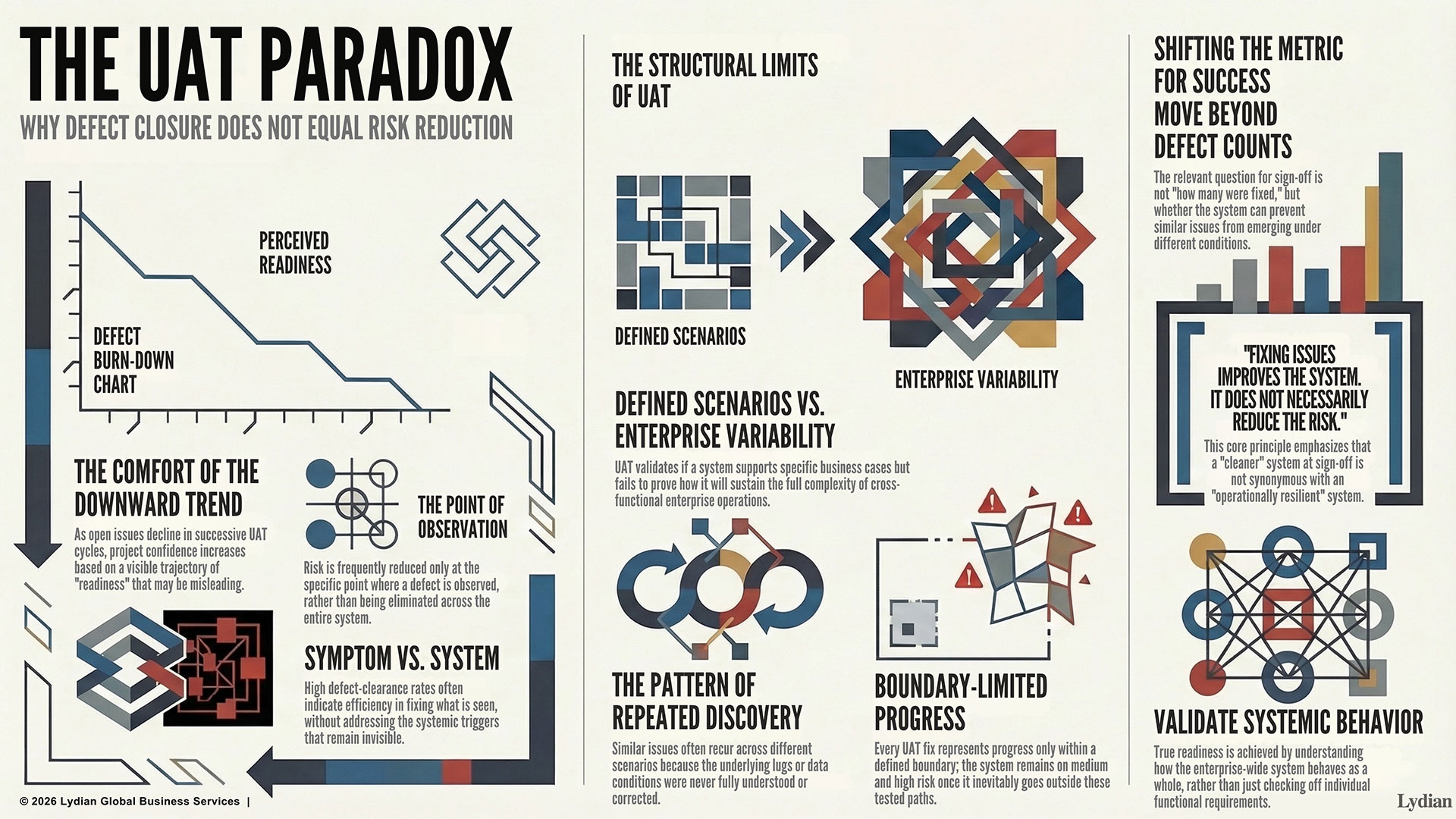
In most SAP programmes, User Acceptance Testing is seen as the final opportunity to identify and resolve issues before go-live. Defects are logged, prioritised, and fixed in successive cycles. As the number of open issues declines, confidence increases. From a programme perspective, this creates a visible trajectory toward readiness. Problems are being found and addressed. The system appears to be improving with each iteration.
What UAT Fixes Actually Achieve
Fixing issues during UAT ensures that identified defects are corrected within the scenarios in which they were discovered. Transactions that previously failed now execute as expected. Data inconsistencies are resolved within the tested context. Each fix represents progress within a defined boundary, and collectively, these fixes contribute to a cleaner system at the point of sign-off.
The Illusion of Risk Reduction
The assumption that fixing defects reduces overall risk is intuitive, but incomplete. Each fix addresses a known issue within a known scenario. It does not necessarily confirm that the underlying conditions that allowed the issue to arise have been fully understood. Nor does it guarantee that similar issues will not appear under different circumstances. Risk is reduced at the point of observation, not eliminated across the system.
The Pattern of Repeated Discovery
A common pattern in UAT is the recurrence of similar issues across different scenarios. Defects are resolved in one context, only to reappear in another. This repetition is often treated as normal testing progression. In reality, it may indicate that validation is focused on symptom resolution rather than systemic understanding. The programme becomes efficient at fixing what it sees, without fully addressing what it does not.
The Structural Limitation of UAT
UAT is inherently scenario-based. It validates whether the system supports defined business cases, not whether it can sustain the full variability of enterprise operations. As a result, the programme may achieve high defect closure rates while still leaving gaps in cross-functional behaviour, data consistency, and operational resilience. The system improves within tested paths, but remains unproven outside them.
The Question Before Sign-Off
The relevant question is not how many defects have been fixed. It is whether the system has been validated in a way that prevents similar issues from emerging under different conditions. This requires a shift from focusing on defect closure to understanding systemic behaviour across the enterprise.
Fixing issues improves the system.
It does not necessarily reduce the risk.


