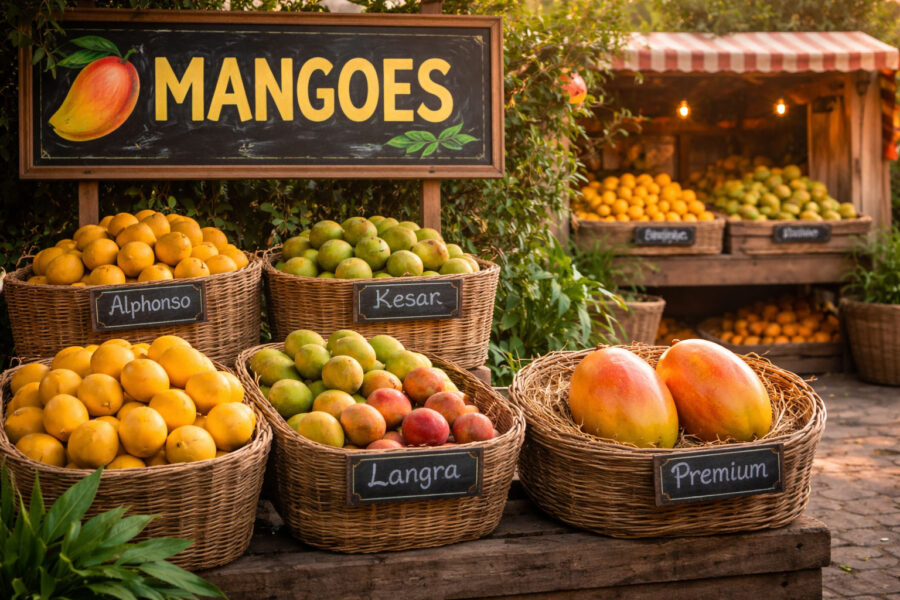
A Curious Observation
India produces more than four hundred varieties of mangoes, each with its own flavour profile, growing region, and seasonal character. Yet when one walks into a typical urban grocery store, the display usually contains only four or five varieties. This looks odd at first glance. If the country grows hundreds of mango types, why do retailers offer so few options to consumers?
The answer lies less in agricultural diversity and more in the economics of retail supply chains.
The Noor Jahan Example
Consider Noor Jahan, a rare mango grown in parts of central India and occasionally described by enthusiasts as the “Dom Pérignon of mangoes.” A single fruit can weigh more than a kilogram and may sell for extraordinary prices in niche markets. Some consumers are willing to pay the equivalent of ten dollars per fruit simply for the experience of tasting it.
From a marketing perspective, this sounds like a dream product. The gross margin potential appears enormous, and the story behind the fruit is powerful. Yet very few retailers bother to carry it regularly.
Unit Economics Over Curiosity
The problem becomes clear once the operational economics are examined. Retailers do not select products purely on gross margins. They consider transportation costs, storage conditions, handling complexity, spoilage risk, shelf space constraints, and store rental economics. Each of these factors influences whether a product is worth carrying.
A rare mango variety that sells five hundred pieces in a week at a high-end store may still fail the operational test. Managing a small consignment during a short harvest season requires coordination with growers, careful logistics, and constant monitoring of freshness. The revenue opportunity may look attractive in isolation, but the effort required to manage the product often outweighs the benefit.
The Scale Constraint
High-margin niche products also face a scale constraint. Even in wealthy urban neighbourhoods, the number of customers willing to pay premium prices for rare fruit remains small. A store may sell a few hundred pieces during a week of peak curiosity, and then demand fades until the next season. Retail operations, however, are built around predictable volumes rather than occasional novelty.
As a result, retailers prefer varieties that move reliably in large quantities. These varieties justify the logistics, storage, and shelf space required to keep the fruit available throughout the season.
Seasonal Supply Logic
Fresh produce supply chains operate differently from most manufactured product categories. For many crops, supply drives demand rather than the other way around. Farmers harvest what the season produces, and markets absorb what arrives. In these circumstances planning models based on elaborate demand forecasting add limited value.
Instead, producers and distributors focus on estimating the revenue they expect to generate during the harvest season. Prices are set for the mass market while allowing a small premium segment to purchase rare or novelty varieties. The objective becomes maximizing seasonal revenue rather than optimizing year-round product availability.
The Perishability Problem
Perishability introduces another harsh reality. A significant share of fresh produce never reaches the consumer in usable condition. Losses occur at every stage of the journey from farm to market. Fruits may be damaged during harvesting, deteriorate during transport, spoil in storage, or simply remain unsold until their quality declines.
Industry estimates often suggest that roughly a quarter of fresh produce is lost somewhere between the farm and the consumer’s kitchen. This loss factor shapes pricing, logistics decisions, and retail assortment choices more than many planning models acknowledge.
What Retailers Actually Optimize
Retailers therefore optimize something different from what many observers assume. They balance shelf productivity, supply reliability, handling effort, and spoilage risk. The assortment that emerges from this calculation tends to favour a handful of high-volume varieties that move quickly and predictably through the store.
The result may appear disappointing to fruit enthusiasts who wish to explore the full diversity of mango cultivation. From the retailer’s perspective, however, the decision reflects a practical response to operational constraints.
The Larger Lesson
The mango example illustrates a broader truth about supply chains. Product availability is rarely determined by consumer curiosity alone. It emerges from a complex balance of logistics costs, storage limits, spoilage risk, demand scale, and retail economics.
When those forces are considered together, the mystery of why hundreds of mango varieties shrink to four or five on the shelf becomes easier to understand. The store is not ignoring diversity. It is simply responding to the arithmetic of the supply chain.