The Licensing Question
Digital access licensing has become one of the most controversial elements of SAP’s commercial framework.
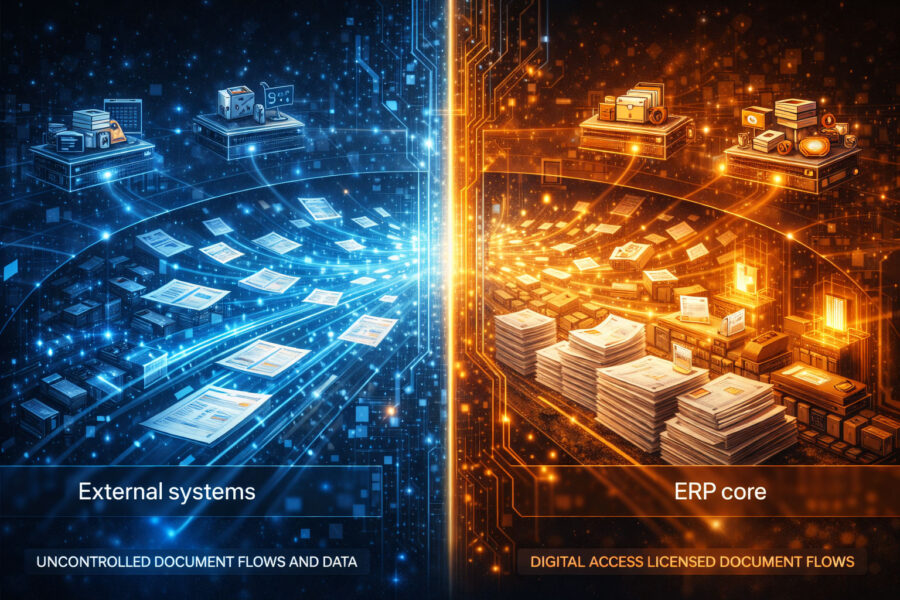
Organizations integrating external systems with SAP ERP or SAP S/4HANA often discover that certain transactions created by those systems trigger additional licensing obligations. The moment an external application generates business documents inside SAP, the vendor may classify the activity as digital access.
For technology leaders this raises a practical question.
Is it possible to avoid digital access licensing altogether?
The short answer is that ethical avoidance is difficult. Contractual obligations define how SAP software may be used, and those contracts determine whether digital access fees apply.
Technical discussions therefore need to be separated from licensing reality.
Technical Workarounds
Within traditional on-premise SAP landscapes, some technical methods exist that appear to bypass digital access detection.
For example, organizations can transfer data files through secure file transfer mechanisms and process those files inside SAP through background jobs. The system might treat these activities as internal processes triggered by a human user.
From a purely technical perspective, the ERP system simply processes a file and creates documents.
However such approaches do not necessarily protect the organization from contractual interpretation during license audits. If the originating system is clearly external and the integration creates SAP business documents, the vendor may still classify the activity as digital access.
Technical design does not override contractual definitions.
Cloud Differences
The feasibility of such technical approaches also changes depending on the SAP deployment model.
In traditional on-premise environments or private cloud installations, administrators often retain access to operating system level functions and system directories. These capabilities allow more flexibility in designing file-based integration patterns.
Public cloud environments operate differently.
Multi-tenant public cloud systems restrict access to operating system components and server level functions. Integration therefore occurs through controlled application interfaces rather than direct file manipulation within the server environment.
This architectural restriction reduces the ability to design certain workarounds that exist in older system landscapes.
Document Triggers
Digital access licensing usually activates when external systems create specific categories of business documents within SAP.
Examples include sales orders, inbound or outbound deliveries, billing documents, purchase orders, service or maintenance records, material documents, manufacturing orders, quality management records, and financial accounting entries.
These documents represent core transactional objects in the ERP system.
When an external application automatically generates such documents, SAP considers that system to be interacting with the digital core of the enterprise application.
The licensing framework therefore measures access based on document creation rather than user logins.
RISE Considerations
Organizations subscribing to programs such as RISE with SAP sometimes assume that digital access concerns disappear within the subscription model.
In principle this assumption is incorrect.
Unless the commercial agreement explicitly modifies the licensing structure, digital access terms may still apply. Some enterprises negotiate temporary waivers or bundled licensing arrangements as part of broader transformation programs, but these arrangements depend entirely on the specific contract negotiated with SAP.
Technology teams should therefore review licensing clauses carefully rather than relying on general assumptions about bundled services.
Integration Platforms
Another common question involves the use of SAP integration platforms such as SAP Cloud Integration or related middleware technologies.
Using SAP middleware does not automatically eliminate digital access licensing considerations. If the middleware simply acts as a conduit between an external system and SAP while generating business documents inside the ERP system, the underlying licensing logic may still apply.
The middleware improves reliability, error handling, and governance of the integration process. It does not necessarily change the commercial classification of the transaction.
Integration architecture and licensing classification remain separate issues.
Cost Structure
Digital access charges are usually calculated based on the number of relevant documents created in the ERP system.
Not all document types carry identical weights. Certain financial documents may count as fractional units compared with full operational documents. The exact pricing depends on negotiated commercial terms and the structure of the enterprise agreement.
Organizations often estimate that each qualifying document may cost a small fraction of a traditional user license equivalent. In high transaction environments those costs can accumulate quickly.
The precise number always depends on the commercial relationship between the enterprise and SAP.
Strategic Perspective
The deeper lesson lies beyond individual integration techniques.
Enterprises implementing external supply chain planning systems, analytics platforms, or customer applications must evaluate integration architecture together with licensing implications. Creating thousands or millions of ERP documents through automated interfaces can have financial consequences that were not originally anticipated during system design.
Technology leaders therefore need clarity before building such integrations.
Questions about document volumes, integration frequency, and system boundaries should be discussed with both technical architects and commercial stakeholders.
The Contract Reality
Some executives perceive digital access licensing as restrictive or unfair.
Yet enterprise software licensing often resembles regulated engineering environments. When organizations purchase complex equipment such as aircraft or industrial machinery, they cannot freely replace core components with unapproved alternatives without affecting certification and warranty conditions.
Enterprise software licensing operates in a similar way.
The vendor defines how the platform may be used, and the contract governs those boundaries.
Technology teams can design creative architectures within those limits, but they cannot assume that technical ingenuity alone overrides commercial agreements.
Understanding that distinction early in a transformation program usually prevents expensive surprises later.