Sequencing Rules and Why “First Come, First Served” Is Rarely Right
Synopsis
Manufacturing schedules rarely fail because the system cannot calculate a sequence. They fail because no one agreed on what the sequence should optimise.
This is Part 2 of our three-part series using a pizza kitchen to explain manufacturing scheduling concepts in practical terms. After exploring setup times and sequencing impact in Part 1, this article focuses on sequencing rules, known in SAP as heuristics, and why seemingly fair logic like “first come, first served” often produces poor outcomes.
Whether it is shortest processing time, earliest due date, or grouping similar jobs to reduce changeovers, each rule prioritises a different objective. Through a simple analogy, the article shows how every sequencing choice improves something while quietly worsening something else.
The key insight is that scheduling systems do not make decisions. They follow instructions. If those instructions are unclear, misaligned, or never discussed in business terms, the output will feel arbitrary and untrustworthy.
Part 2 highlights why sequencing must be a conscious managerial choice, adjusted to context, bottlenecks, and business priorities, rather than a fixed technical setting.
Part 3 will address what happens when schedules meet disruption and how good setups absorb reality instead of amplifying chaos.
Main Article
In Part 1, we spoke about setup times, setup groups, and why the order in which work is executed can quietly decide whether a factory runs smoothly or constantly feels rushed.
Now, let us talk about what actually decides that order.
In SAP and most scheduling systems, this is handled through what are called sequencing rules or heuristics. That word sounds intimidating, but the idea is simple. A heuristic is just a rule of thumb the system uses to decide which job goes first when several are waiting for the same resource.
Once again, the pizza kitchen helps.
Imagine five pizza orders waiting and only one oven. You cannot bake them all at once. Something has to go first.
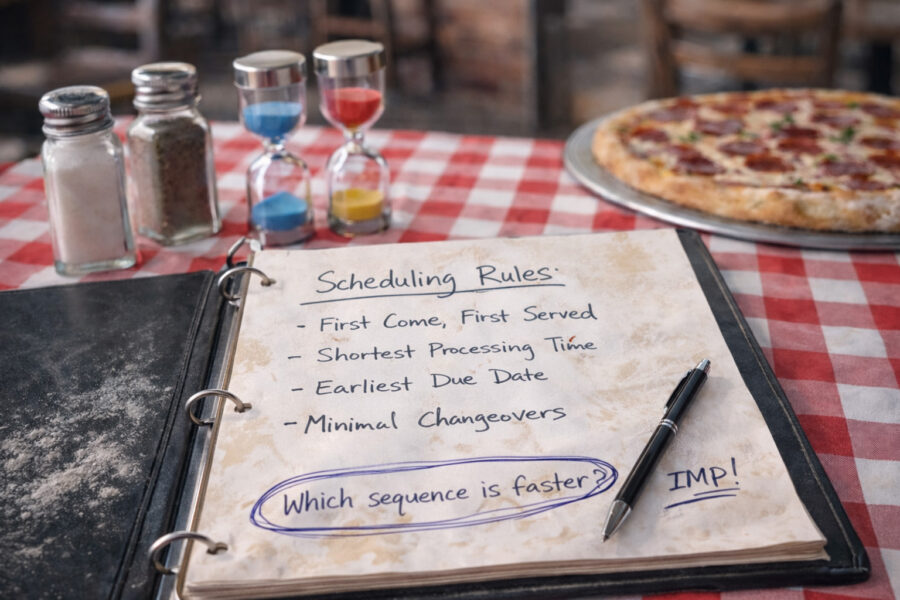
- One obvious rule is first come, first served. Whoever ordered first gets baked first. Fair. Simple. And often inefficient.
- Another rule is shortest processing time first. Make the pizzas that take the least time first, clear the queue quickly, and reduce overall waiting. Great for throughput. Not so great if a large order is already late.
You could choose earliest due date first, where the pizza promised to the most impatient customer jumps the line. This reduces lateness, but may increase setup time if it causes frequent switching between pizza types.
You could group similar pizzas together. All vegetarian first, then all meat, then seafood. This minimises changeovers and keeps the kitchen calm. But it may delay one unlucky customer at the end of the group.
None of these rules is wrong. Each simply optimises for a different outcome.
This is where many scheduling projects quietly go off track.
Teams often expect the system to magically find the perfect sequence. In reality, the system can only optimise what you tell it to care about. Cost. Lateness. Utilisation. Setup reduction. Pick two or three and the others will suffer.
In assembly line manufacturing, sequencing often focuses on smooth flow and balanced stations. In job shop environments, where each order follows a different path, sequencing becomes a daily decision rather than a one-time setup.
The mistake is assuming one rule fits all situations.
Friday afternoon in a pizza shop looks very different from Monday morning. Bottlenecks move. Priorities change. Customers behave differently. Good scheduling systems allow planners to switch heuristics consciously, not blindly accept what the system proposes.
This is also where the role of the planner or MRP controller becomes critical. The system produces a plan. A plan is not a schedule. A schedule requires judgement, context, and sometimes a deliberate override.
If your scheduling tool feels like a black box that produces results no one trusts, the issue is rarely the algorithm. It is usually that the sequencing logic was never discussed in business terms.
In Part 3, we will address what happens when reality intervenes. Machines break. Quality fails. A key ingredient does not arrive. And the beautiful schedule collapses. We will look at how good scheduling setups absorb disruption instead of amplifying it.
If these trade-offs sound familiar, it is because every factory lives with them every day. At Lydian, this is the conversation we start with before touching configuration or software.
If you want to talk about sequencing, scheduling, and planner decision-making in plain business language, you can start that conversation at lydiangbs.com.