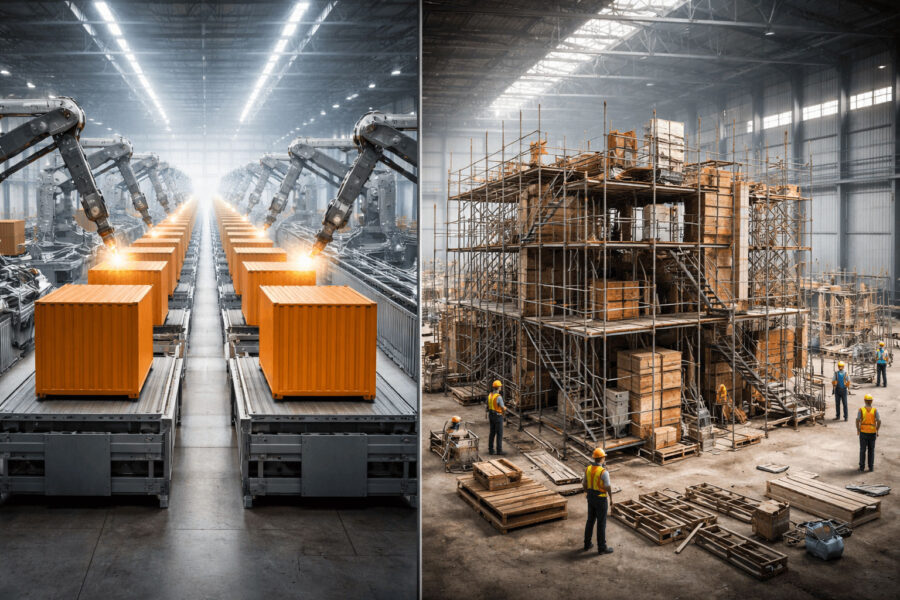
Strange Economic Pattern
Technological progress does not always move evenly across industries. Some sectors achieve remarkable efficiency within a few decades. Others remain structurally expensive even as the underlying technology improves dramatically. Enterprise software sits in that second category.
Consider the broader arc of engineering history. The journey from early steam engines to modern jet engines took roughly four centuries. Over that period engineers refined metallurgy, thermodynamics, and manufacturing techniques until air travel became routine. By contrast the evolution of enterprise computing happened much faster. Flat file systems appeared in the early decades of digital computing. In less than seventy five years those primitive structures evolved into in-memory platforms such as SAP HANA that can process vast volumes of enterprise data almost instantly.
The technology moved quickly. The economics surrounding it did not.
Manufacturing Efficiency Lessons
Manufacturing industries provide an interesting comparison. Over many decades the automotive sector refined the art of building durable machines at predictable cost. Today a buyer can purchase a reliable vehicle for less than four thousand dollars in some markets. Others may choose a vehicle costing fifty thousand dollars or more. Both categories generally last more than fifteen years when maintained properly.
This outcome did not appear by accident. Manufacturers constantly questioned cost structures. Engineers simplified components. Production lines became more efficient. Supply chains were optimized. Every part of the process faced relentless economic pressure.
That discipline produced predictable economics.
Enterprise software rarely experiences the same pressure.
ERP Implementation Puzzle
Organizations regularly purchase ERP software that already contains the core business logic required to run procurement, manufacturing, finance, and sales operations. The product exists. The license grants access to the intellectual property that vendors spent decades developing.
Yet the moment implementation begins the timeline expands dramatically. Large consulting teams arrive. Workshops multiply. Configuration cycles stretch for months. Integrations require additional work. Custom reports appear. Extensions accumulate.
A project that began with an off-the-shelf product often turns into a year long effort involving large consulting budgets.
This pattern deserves scrutiny.
Consulting Structure Reality
The ERP consulting industry evolved around this complexity. System integrators employ large global workforces who specialize in configuring enterprise platforms. Consultants analyze business processes, interpret configuration settings, build integrations, and create reporting frameworks. Their knowledge helps organizations navigate complicated systems that appear difficult to operate without expert guidance.
The structure persists because customers continue to pay for it.
Yet many projects reveal an uncomfortable detail. Some development work produces limited business value. A custom report might require weeks of effort even though a small group of users may access it only a few times each year. Minor variations in process flow may trigger additional development simply because legacy habits must be preserved.
The system becomes heavier with every addition.
Economic Question Raised
At some point a practical question emerges. Why should implementing software that already exists require hundreds of consulting days? A license fee represents payment for intellectual property. That part of the economic exchange makes sense. Vendors built the product and deserve compensation.
Implementation economics are less clear.
When organizations routinely spend large amounts configuring standard functionality, the industry must examine whether structural inefficiencies remain embedded within the deployment process.
Manufacturing industries constantly challenge such inefficiencies.
Enterprise software rarely does.
Wizard Configuration Future
The long term direction of enterprise software may eventually address this imbalance. A different configuration philosophy could reduce the complexity of system deployment. Instead of requiring consultants to translate business requirements into technical settings, systems could guide organizations through structured questions describing how the business operates.
A configuration wizard would ask telescoping questions about procurement policies, manufacturing processes, financial structures, and reporting requirements. The answers would automatically generate appropriate system configurations behind the scenes. Business users would describe their operations in plain language while the platform assembled the technical framework automatically.
Such systems would not eliminate complexity entirely. Large enterprises contain complicated operations. Yet the translation between business logic and system configuration could become dramatically simpler.
Consulting Industry Impact
If deployment becomes easier, the consulting economy surrounding ERP will inevitably change. Fewer resources would be required for basic system configuration. Consulting firms would shift toward architectural advisory roles rather than large scale implementation teams. Expertise would focus on integration strategy, enterprise data models, and governance structures rather than routine system setup.
Consultants would still exist. Their role would simply evolve.
Industries frequently experience this kind of transition when tools become easier to use.
Economics Eventually Correct
Markets eventually correct structural inefficiencies when better tools appear. Enterprise software has already improved dramatically over the past several decades. The remaining inefficiency lies in how these systems are deployed and configured.
One day the implementation process may resemble installing sophisticated business software rather than constructing it piece by piece through large consulting projects.
When that moment arrives the economics of ERP will look very different.
The software already exists. The question is how long the industry continues behaving as though it does not.