
The Confidence That Comes From Passing Tests
At MedAxis Pharma (name and operational specifics changed to protect identities), a multi-site pharmaceutical manufacturer operating under strict GMP and regulatory controls, the SAP S/4HANA programme had achieved what most programmes aim for. SIT cycles were completed, UAT scripts were executed with over 96% pass rates, integration points across MM, PP-PI, QM, EWM, and FI/CO were signed off, and validation documentation aligned with regulatory expectations. Batch-managed inventory, inspection lots, usage decisions, and release processes behaved exactly as designed in controlled runs. The programme team concluded, with reasonable confidence, that the system had been tested thoroughly.
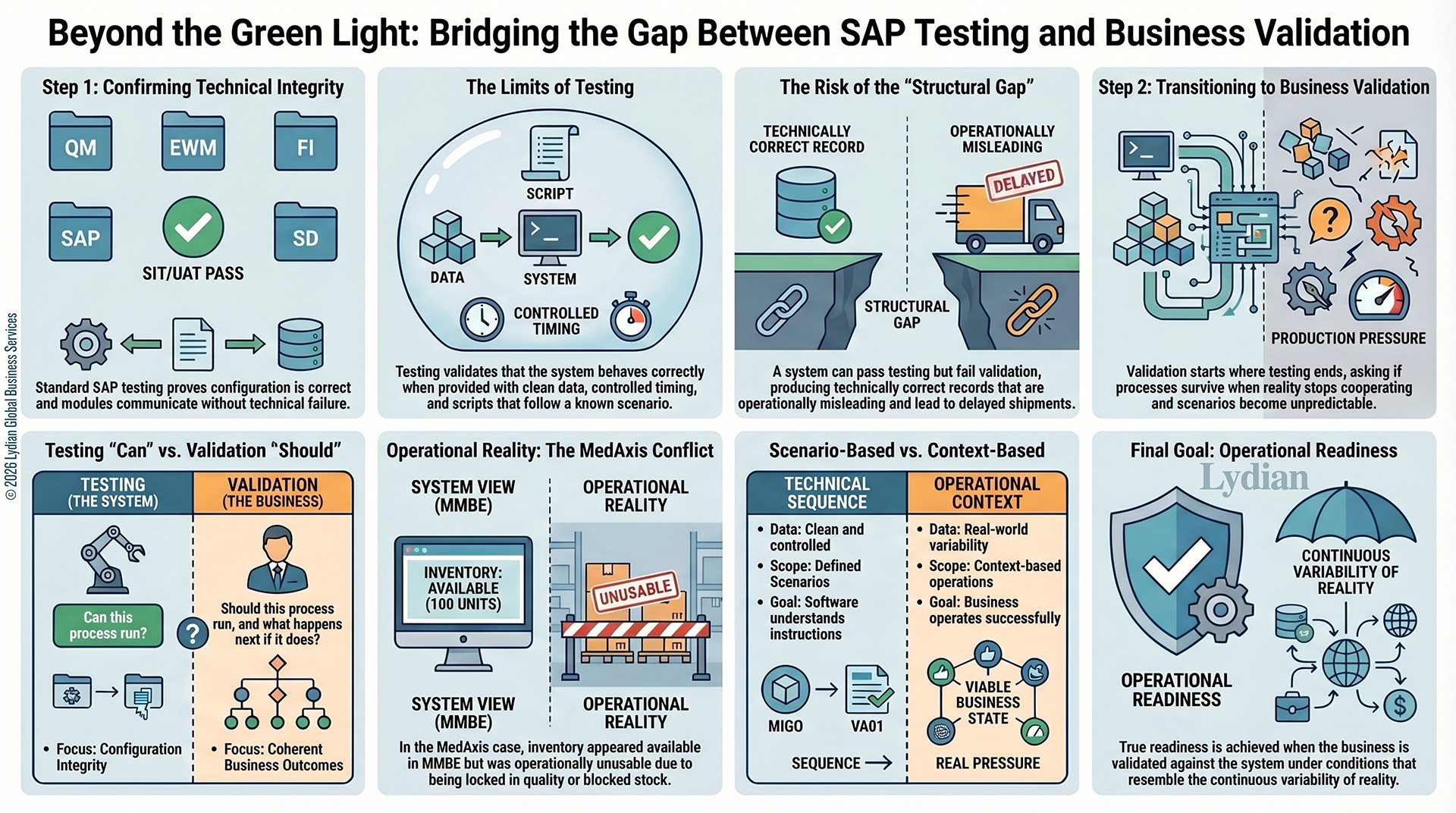
That conclusion was technically correct. It was also incomplete. Testing proves that the system behaves correctly when asked the right questions. It does not prove that the business will behave correctly when the system is live. In a pharmaceutical environment, that distinction matters more than in most industries because every production order, batch movement, quality decision, and financial posting sits inside a regulatory and operational context that is far less predictable than a test script.
What SAP Testing Actually Proves
From a SAP standpoint, testing validates configuration integrity. PP-PI orders can be created, process instructions executed, goods issues posted through MIGO, confirmations captured, and goods receipts recorded into batch-managed stock. QM inspection lots are generated automatically, quality results recorded, and usage decisions applied correctly. Batch determination works during goods issue, shelf-life expiry checks behave as expected, and FI/CO postings reflect standard and actual cost flows through variance settlement. Integration testing ensures that MM, PP, QM, EWM, and FI talk to each other without technical failure.
Now let us translate that into Lydian English. The system has been taught how to behave when the scenario is known, the data is clean, the timing is controlled, and the people executing the process are following the script. That is what testing proves. It proves that the software understands the instructions given to it.
Where Business Validation Begins
Business validation starts where testing ends. It asks whether those same flows survive when reality stops cooperating. In MedAxis, the first signs of divergence appeared not as system failures but as decision conflicts. A batch passed quality inspection in QM, but downstream distribution could not reconcile expiry prioritisation across multiple warehouses. A production order consumed components correctly, but the physical staging of materials in EWM did not align with what the shop floor experienced. Inventory appeared available in MMBE, but was partially locked in quality or blocked stock, making it operationally unusable.
In SAP language, everything was functioning. Inspection lots were closed, batches were released, stock was posted, and FI reflected the movement. In business language, planners, warehouse managers, and quality teams were no longer aligned on what could actually be shipped, consumed, or invoiced. That is the difference between testing and validation. Testing confirms that events can occur. Validation confirms that those events produce coherent business outcomes.
The Structural Gap Between the Two
The gap emerges because SAP testing is scenario-based, while business validation is context-based. Testing asks, “Can this process run?” Validation asks, “Should this process run, and what happens next if it does?” Testing executes VA01, CO11N, MIGO, QA32, and VF01 in sequence. Validation asks whether the combination of those transactions, across multiple plants, batches, and timelines, still represents a viable business state.
Consider batch genealogy. Testing confirms that batch traceability exists, that movement history is captured, and that audit trails can be produced. Validation asks whether, under real production pressure, substitutions, rework loops, and partial consumption still produce a traceable and defensible lineage. Testing confirms that FI postings are correct. Validation asks whether those postings reflect the economic reality of inventory, cost, and revenue when operations deviate from plan.
In Lydian speak, testing checks whether the system can answer questions. Validation checks whether the answers make sense when the business starts asking its own.
Why This Distinction Matters
In regulated industries, the cost of confusing the two is not limited to inefficiency. It becomes a matter of compliance, auditability, and trust. A system that passes testing but fails validation can produce technically correct records that are operationally misleading. That leads to delayed shipments, rejected consignments, reconciliation gaps, and regulatory scrutiny. More importantly, it forces the business into manual alignment mechanisms that sit outside the system, which undermines the very purpose of an ERP.
Leadership often assumes that high test coverage translates to readiness. It does not. It translates to coverage of defined scenarios. The enterprise, however, does not operate within defined scenarios. It operates within continuous variability across demand, supply, quality, and timing. The question is not whether the system was tested. The question is whether the business was validated against that system under conditions that resemble reality.
Testing tells you the system works.
Validation tells you whether the business will.

