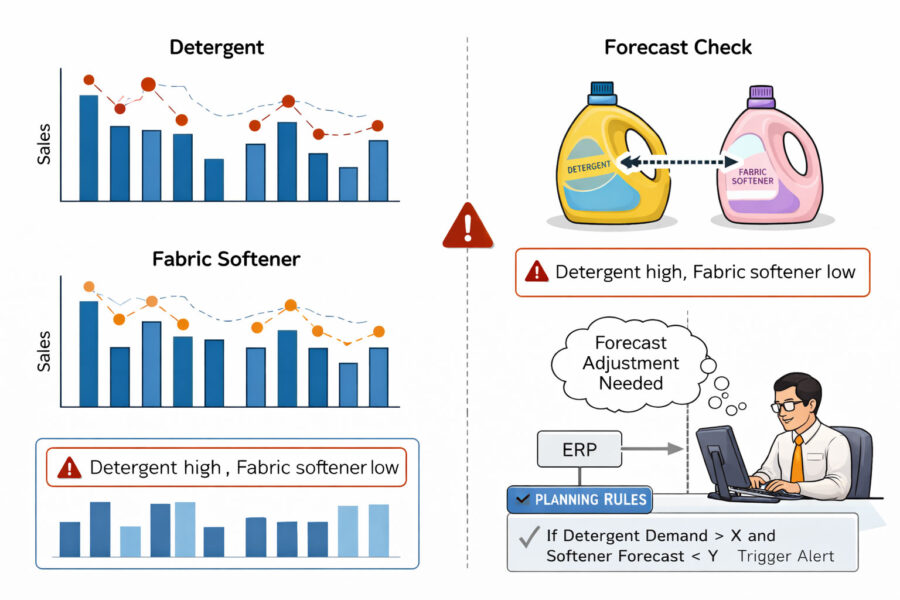
Forecast Correction Problem
Demand planners often encounter a familiar difficulty. Forecast accuracy for individual products may appear reasonable while the combined behavior of related products looks inconsistent.
Many items sell together. Detergent often drives fabric softener. Printers drive cartridges. Shampoos often pull conditioners along with them. Retail demand reflects how customers actually use products rather than how planning systems organize them.
Forecasting systems frequently treat each SKU as an independent statistical entity. Each product receives its own demand model, its own history, and its own projected future. The interaction between products disappears from view.
This creates subtle distortions in supply planning.
Companion Product Signals
Consider a simplified example involving detergent and fabric softener. Over twelve weeks of sales history the detergent appears regularly in demand records. The softener appears during many of those weeks as well. When detergent demand disappears, softener demand disappears too.
A planner examining the history immediately recognizes the relationship. The softener behaves like a companion product. Its sales depend heavily on the presence of detergent demand.
The forecasting system, however, may not interpret the relationship the same way.
Standard statistical models often evaluate each product independently. The system forecasts detergent demand based on detergent history and forecasts softener demand based on softener history. The logical dependency between the two remains hidden.
Correlation Shortcomings
Analysts frequently attempt to detect such relationships using correlation. Correlation measures whether two variables move together in a linear pattern.
Retail demand rarely behaves so neatly.
A companion product may appear only when another product sells, while the quantities vary widely. This pattern produces low correlation because the numerical relationship between the volumes fluctuates.
Yet the behavioral relationship between the products remains strong.
The mathematical tool fails to capture what the planner intuitively understands.
Mutual Information Concept
Information theory provides a more flexible way to measure such relationships. Mutual information measures how much knowledge about one variable reduces uncertainty about another variable.
Unlike correlation, mutual information detects nonlinear and categorical dependencies. It identifies situations where one product tends to appear whenever another product sells even when the quantities vary.
In the detergent and softener example the mutual information signal would be strong. The system learns that softener demand becomes far more likely whenever detergent demand appears.
The relationship becomes visible to the planning system.
Operational Rule Logic
Once the relationship becomes measurable, planners can translate the insight into operational rules.
Suppose detergent sales appear in the current forecast cycle while the forecast for softener remains unusually low. The planning system can flag the situation as a possible forecasting imbalance.
A simple macro can perform this check automatically. If detergent demand exceeds a threshold and the softener forecast falls below an expected ratio, the system raises an alert for review.
The planner then decides whether the forecast requires adjustment.
This rule does not attempt to predict demand perfectly. It simply highlights situations where historical relationships appear to be violated.
Where It Helps
For routine warehouse replenishment this insight may not change much. Distribution networks often replenish inventory based on past consumption patterns regardless of cross product relationships.
However several planning situations benefit from this knowledge.
Deployment planning provides one example. When companies allocate inventory across warehouses, companion product relationships help determine where stock should be positioned.
Retail promotion planning offers another use case. If detergent demand historically pulls softener demand along with it, promotions can exploit that pattern.
E commerce assortment planning also benefits. Product recommendation engines rely heavily on similar signals to suggest related purchases.
Simple Analytics
Modern technology discussions often leap immediately to artificial intelligence. Many practical forecasting improvements require far simpler methods.
Mutual information calculations can be produced using straightforward statistical programs. Even modest analytical tools can compute these relationships across thousands of SKU pairs.
Once identified, the relationships can be translated into basic planning rules inside ERP or demand planning systems.
The mathematics remains elegant. The implementation remains simple.
Commercial Perspective
Implementing such logic rarely requires a massive project. A small analytical exercise followed by modest rule configuration may suffice. In many organizations the entire exercise could be completed within a short development cycle.
The real value lies in understanding where these product relationships influence commercial outcomes. Not every pair of products deserves such attention.
Planners must decide where the signal matters to the business.
Closing Aside
Credit for introducing this idea in practical supply chain planning goes to Venkat Kalakkad, who patiently explained when mutual information actually helps and when it does not.
Should anyone feel tempted to hire him immediately after reading this article, a small procedural note applies. Please contact Lydian first.
Intellectual property has its own supply chain. Venkat remains one of the scarce resources in it.