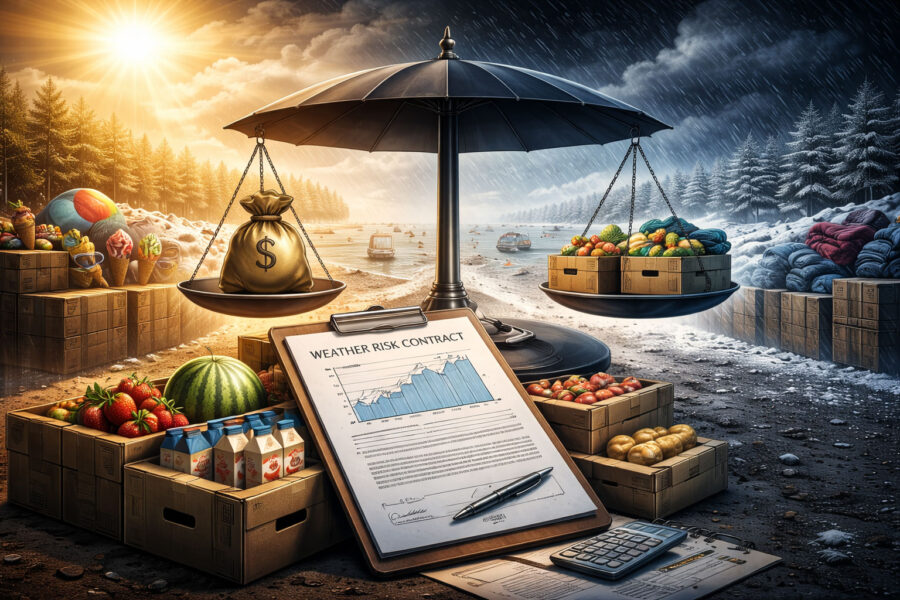
Systemic Versus External Risk
Supply chain contract design has been studied extensively in academic literature and has found practical application in many industries. Companies routinely implement agreements such as vendor managed inventory arrangements, price contracts, volume commitments, and capacity reservation agreements.
More sophisticated arrangements also exist. Revenue sharing contracts and buy back agreements are frequently discussed in supply chain management theory and sometimes implemented in retail and distribution networks.
These contractual structures address risks that arise within the supply chain system itself. Forecast errors, demand variability, and coordination problems between suppliers and buyers fall into this category.
The underlying assumption is that both parties influence the demand and supply process.
Some risks originate entirely outside that system.
Weather Exposure
Weather is one of the most obvious external risks affecting supply chains. Certain product categories experience demand patterns that respond strongly to temperature, rainfall, or seasonal conditions.
Ice cream demand increases dramatically during hot weather. Woollen garments sell better during cold seasons. Beverages, seasonal foods, and outdoor products exhibit similar sensitivity.
Retailers carry the largest exposure to this uncertainty. They hold inventory close to the market and must decide stocking quantities before the actual weather conditions become known.
If demand turns out weaker than expected because of unfavorable weather, the retailer absorbs the loss.
This risk becomes especially severe for products with little or no salvage value. Perishable goods and highly seasonal products cannot be stored indefinitely until conditions improve.
Unsold inventory becomes waste.
Risk Transfer
One theoretical solution involves transferring the weather risk to financial markets. Specialized financial institutions can design derivatives that pay out when weather indicators deviate from expected levels.
These instruments operate in a manner similar to insurance contracts. A retailer pays a premium to hedge against adverse weather outcomes. If temperatures fall below a defined threshold during a critical sales period, the derivative generates a payout that compensates for lost demand.
Weather derivatives do exist in financial markets, although they remain relatively uncommon in operational supply chain agreements.
The modeling complexity required to price these contracts limits their widespread adoption.
Contractual Alternative
Another approach keeps the risk management mechanism inside the supplier–retailer relationship.
Weather rebate contracts attempt to redistribute the financial consequences of weather variability between the two parties. Instead of relying on a financial intermediary, the supplier and retailer incorporate weather dependent terms directly into their commercial agreement.
These contracts typically define several parameters.
A strike quantity represents the expected sales level for a product during a specific time window. A strike price determines the rebate value triggered if actual demand falls below that threshold. Weather indicators such as cooling degree days or heating degree days provide objective measures of weather conditions.
When the weather deviates significantly from expectations, the contract activates a rebate mechanism that partially compensates the retailer for unsold inventory.
Risk Balance
The purpose of this structure is not to eliminate risk entirely but to rebalance its distribution.
Retailers face direct exposure to unsold inventory. Suppliers often possess greater financial resilience and may benefit from higher production volumes during favorable conditions. A weather rebate mechanism aligns incentives by sharing the downside risk when environmental conditions disrupt demand.
Such arrangements become particularly valuable in industries where demand volatility is driven by weather rather than by consumer preference changes.
The contract acknowledges that the retailer cannot control the weather.
Analytical Framework
Designing these agreements requires analytical models capable of evaluating tail risks rather than average outcomes. One concept frequently used in such contexts is Conditional Value at Risk, often abbreviated as CVaR.
This measure focuses on extreme loss scenarios rather than on typical demand fluctuations. Instead of asking how much variability occurs on average, CVaR examines the magnitude of losses in the worst cases.
For weather sensitive products this perspective is critical. A few unfavorable days during a peak sales period can destroy the economics of an entire seasonal inventory position.
Practical Adoption
Despite their theoretical appeal, weather rebate contracts remain relatively rare in commercial practice. Negotiating such agreements requires both parties to understand probabilistic modeling and to accept a more sophisticated form of risk sharing.
Large organizations with advanced analytical capabilities are more likely to experiment with such structures.
Financial institutions occasionally participate by providing modeling expertise or hybrid financing mechanisms that combine supply chain financing with risk hedging.
Risk Awareness
Weather risk illustrates an important point about supply chain management.
Not all risks originate from operational inefficiencies or forecasting errors. Some arise from environmental conditions that lie entirely outside the control of supply chain actors.
Traditional contracts address coordination failures within the system. Weather rebate agreements attempt to handle shocks originating beyond it.
Recognizing this distinction expands the scope of supply chain risk management beyond purely operational considerations.