Lifecycle Confusion
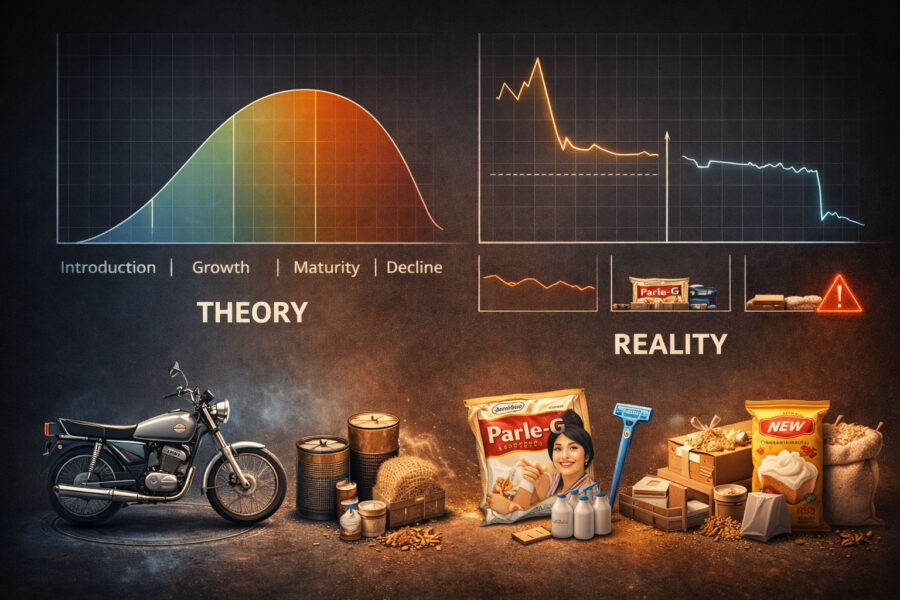
Product Lifecycle Management sounds impressive in presentations. The concept usually appears as a clean curve. A product is introduced, demand grows, maturity arrives, and decline eventually follows. Many management discussions treat this model as if it describes how products behave in real markets.
In practice the idea raises an uncomfortable question. What exactly should a company do differently after learning the definition of a lifecycle curve?
Knowing the theory does not make the future predictable. Markets do not follow diagrams drawn in textbooks.
Some products fail immediately. Others survive for generations.
Early Failure
Many products never reach maturity at all. They appear briefly in the market, generate a few early orders, then disappear. Distributors quietly clear remaining inventory and the organization moves on to the next launch.
This happens far more often than most strategy discussions admit.
Product launches are usually optimistic exercises. Sales teams project growth. Marketing teams highlight differentiation. Management approves production volumes. Reality sometimes disagrees.
Demand simply fails to materialize.
The lifecycle curve in those cases is short and brutal. Introduction moves directly into decline.
Long Survivors
At the opposite extreme are products that refuse to follow the expected lifecycle path.
Consider Parle G biscuits. The product has remained in the Indian market for decades with minimal change in formulation or packaging. Demand has shown remarkable stability despite competition from modern snack brands and constant product innovation across the food industry.
Another example appears in everyday consumer behavior. Disposable razors such as the Gillette Presto remain widely used even though the grooming industry constantly introduces advanced alternatives. Many customers simply continue buying the same product year after year because it works and remains affordable.
These products appear to live permanently inside the maturity phase.
The lifecycle model struggles to explain their longevity.
Disappearing Success
Then there are cases where strong demand does not guarantee survival.
The Yamaha RX100 motorcycle remains legendary among enthusiasts in India. Demand remained strong during its production years and many riders still admire the machine today. Yet the product disappeared from the market.
The reason had little to do with customer demand. Regulatory changes and emission standards altered the economic feasibility of continuing production.
A lifecycle curve based purely on market demand would never have predicted that outcome.
External forces often override demand signals.
What Extends Maturity
Organizations therefore face a more practical question. If the maturity phase can last decades for some products, what allows that to happen?
Several strategies appear repeatedly in successful portfolios.
The first is market expansion. A product that has reached saturation in one region may still find demand in another geography where competition remains limited.
The second involves price segmentation. The same product may be offered in multiple pack sizes or pricing tiers that appeal to different customers. A pack of two units may serve a different buying context than a pack of five even though the product itself remains unchanged.
The third option is product redesign. Sometimes modest changes in packaging, materials, or design refresh the appeal of a mature product without fundamentally altering its identity.
The fourth strategy is creating new customer segments. A product originally designed for one demographic group may find unexpected adoption elsewhere.
None of these strategies guarantee success. They simply increase the probability that maturity lasts longer.
Portfolio Reality
Most companies discover another uncomfortable truth when examining their product portfolios. A small number of products generate the majority of revenue and profit.
In many industries five to eight SKUs carry the financial weight of the entire business. The remaining items provide variety, experimentation, or niche market coverage.
When those core products succeed, the organization prospers. When they fail, the entire portfolio struggles.
This concentration of success rarely appears in lifecycle theory diagrams.
Planning Implications
Product lifecycle thinking still has value if interpreted cautiously. The concept encourages companies to monitor product demand patterns and anticipate eventual decline. However the model should not be treated as a deterministic forecast.
Instead it should serve as a reminder that product demand evolves in unpredictable ways.
Some items disappear quickly despite careful planning. Others continue selling for decades without deliberate lifecycle management. A few vanish even while customers remain enthusiastic.
The most useful lesson for business planning is therefore humility. Product success rarely emerges from perfect forecasting or elegant lifecycle charts.
More often it emerges from a combination of timing, market behavior, operational execution, and occasionally simple luck.