The Planner’s Question
A supply chain planner once asked a question that appears simple.
If a pharmaceutical product carries a maximum shelf life of twenty four months, how large should the production lot be?
Many organizations instinctively answer six months of demand. The reasoning appears logical. A product that legally lasts two years seems capable of absorbing inventory produced in larger batches.
In real pharmaceutical markets, the answer is usually very different.
Distributors, pharmacies, and hospitals rarely treat the legal shelf life as the real selling window. Once a drug begins to age, buyers become cautious. By the fifteenth month many distributors start viewing the product as approaching expiry. Their downstream customers will hesitate to accept it. Their warehouse managers will prefer inventory that looks newer.
The practical selling window therefore becomes much shorter than the official shelf life.
Understanding this difference changes how production planning should work.
Commercial Shelf Life
Experienced pharmaceutical planners understand that the market reacts to product age long before the legal expiry date.
A drug may technically remain stable for twenty four months. The distribution channel may behave as though the product has fifteen months of commercial life. Sometimes the window is even shorter depending on therapy area, demand volatility, and distributor policies.
This difference creates a structural planning constraint.
If production batches cover too much demand, inventory begins aging in the distribution network. By the time the product reaches customers, the remaining shelf life may appear unattractive. Sales teams then struggle to move the inventory.
For this reason many mature pharmaceutical supply chains apply a practical guideline.
Production lot sizes should rarely exceed roughly three months of demand.
This rule does not originate from software configuration. It comes from observing how products actually move through supply chains.
The Lot Size Trap
Manufacturing teams often prefer larger production runs. Larger batches reduce changeovers and improve utilization of expensive equipment. Finance teams sometimes support the idea because it spreads fixed production costs across larger quantities.
Those arguments focus on factory efficiency.
Supply chains must focus on inventory behavior.
When production lots cover six months of demand or more, inventory begins accumulating in warehouses and distribution centers. The longer that stock sits in the network, the closer it moves toward the perceived expiry window.
Once buyers start worrying about product age, the problem becomes difficult to reverse.
The system may show adequate inventory. The market may refuse to consume it.
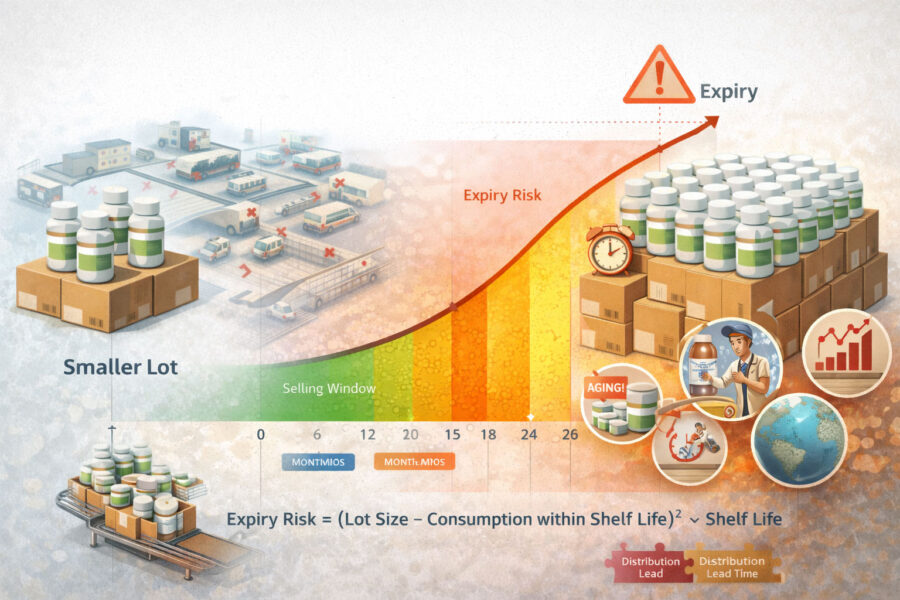
Expiry Risk Curve
Strategy consultants sometimes explain this dynamic using a simplified analytical model.
Expiry Risk = (Lot Size − Consumption within Shelf Life)² ÷ Shelf Life
The exact formula is less important than the concept behind it.
When production volumes exceed what the market can realistically consume within the effective shelf life window, the probability of expiration rises rapidly. The relationship grows faster than linearly. Small increases in lot size can produce large increases in expiry exposure.
Several operational factors amplify this effect.
Forecast errors distort demand signals. Distribution lead times delay product availability in regional warehouses. Deployment decisions sometimes concentrate inventory in locations where demand develops more slowly.
These factors combine to accelerate the aging of inventory.
Lessons From Food
The same behavior appears in industries with very short shelf lives.
Consider potato chips manufactured with fresh sour cream. In several markets the legal shelf life is around three months because of ingredient stability and regulatory requirements.
Retailers understand consumer behavior well. When the expiry date approaches, shoppers stop picking up the product.
Food manufacturers still produce large batches because their products move very quickly through retail channels. Even with high sales velocity, supply chains commonly experience five to seven percent expiry losses.
The numbers become larger in beverages and baked goods. Expiry losses can reach fifteen to twenty five percent because distribution networks are wide and retail turnover varies.
Pharmaceutical supply chains cannot tolerate losses at that level.
Expired medication produces regulatory exposure, financial write offs, and operational complications across the supply network.
Many Shelf Lives
Planning complexity increases further because pharmaceutical products rarely operate with a single shelf life definition.
Several related concepts often exist simultaneously.
Best before date, maximum shelf life, total shelf life, minimum remaining shelf life, customer expected shelf life, expiration date, warehouse shelf life, and regulatory shelf life all influence operational decisions.
Inside SAP systems these parameters interact with batch management settings, material master data, planning logic, and deployment strategies.
The system does not correct unrealistic assumptions.
If production planning ignores commercial shelf life, the software will execute the plan faithfully. The resulting inventory will age across the distribution network.
Organizations then attempt reactive solutions. They push inventory into secondary markets. They discount aging stock. They accelerate shipments into regions that were never part of the original demand plan.
Those actions treat symptoms.
Structural Planning
The real issue begins with production lot sizing and the assumptions behind it.
When planners recognize that commercial shelf life differs from regulatory shelf life, the entire planning conversation changes. Smaller batches begin to look sensible. Deployment timing becomes more important. Forecast accuracy receives more attention.
Enterprise systems such as SAP reveal these structural decisions very clearly.
They do not create the problem.
They simply make the consequences visible.
Understanding that distinction often requires experience.
Occasionally it requires a short discussion that costs two samosas and one cup of chai.