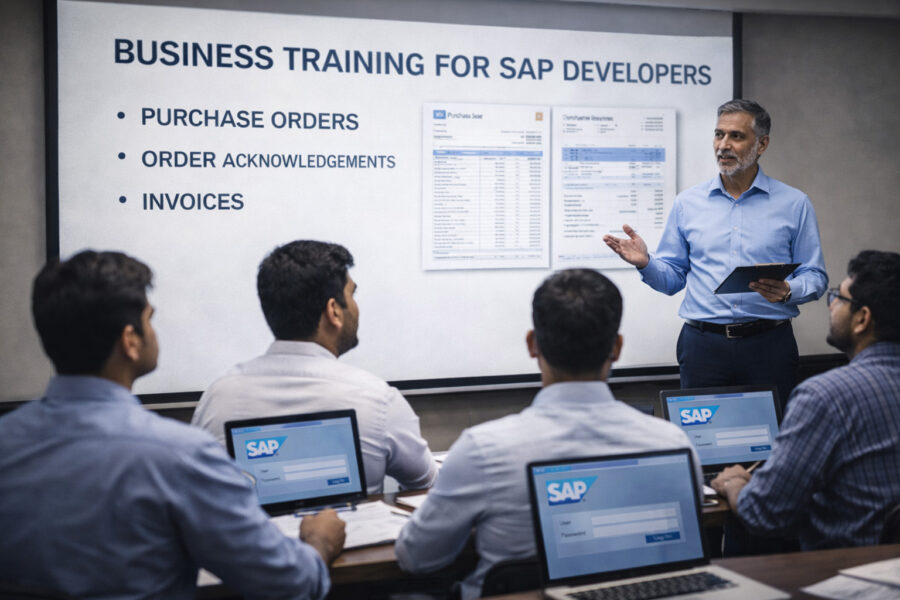
Every SAP developer should be required to pass a short, structured business course before writing production code.
Not a management theory course. Not a certification add-on. A basic, practical grounding in how businesses actually work.
Start with something simple. Do you know what a purchase order really is? Not the SAP screen, but the business document. What it must legally contain. What is optional. How long a large purchase order is typically consumed. What it means when a company raises a purchase order for material that will be delivered over months, not days.
Then move to everyday transactions. How people buy things in real life. Cash, credit cards, subscriptions, instalments. What an order acknowledgement is and why companies send it. Where that acknowledgement lives in a system. What happens to it downstream in accounting, logistics, and compliance.
Read an invoice. A real one. Not a demo. Understand why it exists, what makes it valid, and when it is legally required. Know the difference between an invoice, a bill, a receipt, and a pro forma invoice. Understand what tax lines mean and when they can or cannot be reclaimed.
Most developers enter projects having mastered screens, tables, and syntax, but with little understanding of the business meaning behind the data they manipulate. They build what they are told to build, rarely stopping to ask what problem it solves, or whether the system already does it. The result is predictable. Custom code where configuration would suffice. Logic that works technically but makes little business sense.
Communication makes this worse. In many projects, developers and functional consultants spend weeks talking past each other. Requirements are discussed endlessly, clarified repeatedly, and rewritten again. Not because the problem is complex, but because it is not being expressed clearly. Plain business English is not a soft skill. It is a delivery skill.
The cost is visible in every large SAP programme. Excessive meeting time. Slow progress. Rework. Ten percent of effort spent building, and the rest spent explaining.
This can be fixed. But only if developers are taught to see beyond the screen, understand the business document behind the transaction, and communicate clearly about what they are building and why.
At Lydian, we believe better systems start with better understanding. If you are a developer who wants to learn the business side properly, or an organisation struggling with this gap on SAP projects, that is a conversation worth having.
You can reach us at lydiangbs.com.